
Sommaire
Définition du produit scalaire
Définition
Le produit scalaire d’un vecteur \overrightarrow{u} par un vecteur \overrightarrow{v} est le nombre réel \overrightarrow{u}.\overrightarrow{v} qui se lit \overrightarrow{u} scalaire \overrightarrow{v}.
Si \overrightarrow{u}=\overrightarrow{AB} et \overrightarrow{v}=\overrightarrow{AC} alors \overrightarrow{u}.\overrightarrow{v}= \overrightarrow{AB}.\overrightarrow{AC}=AB\times AC\times cos(\widehat{BAC})
Si \overrightarrow{u}=\overrightarrow{0} ou \overrightarrow{v}=\overrightarrow{0} alors \overrightarrow{u}.\overrightarrow{v}=0 .
Exercice n°1
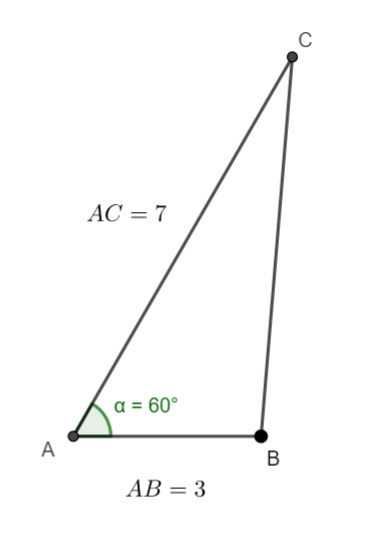
En utilisant la définition, calculer le produit scalaire \overrightarrow{AB}.\overrightarrow{AC}
Exercice n°2
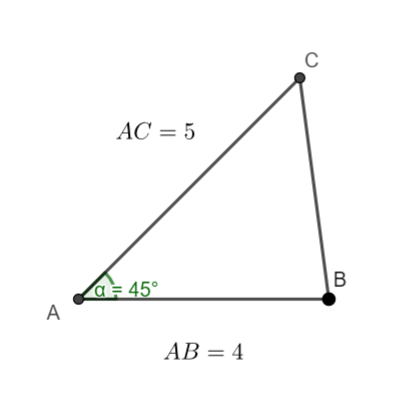
En utilisant la définition, calculer le produit scalaire \overrightarrow{AB}.\overrightarrow{AC}
Exercice n°3
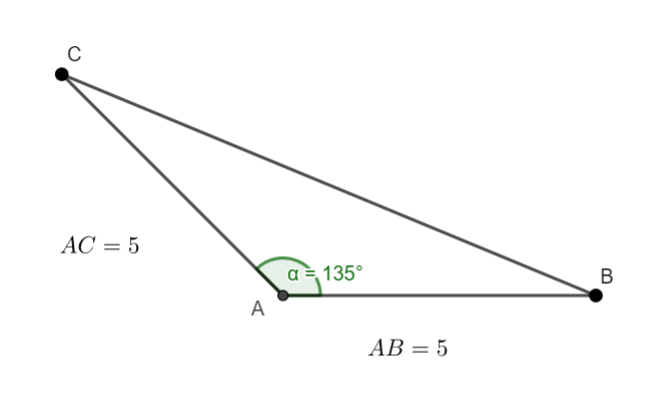
En utilisant la définition, calculer le produit scalaire \overrightarrow{AB}.\overrightarrow{AC}
Le produit scalaire et la projection orthogonale
Propriété
\overrightarrow{u}.\overrightarrow{v}=\overrightarrow{AB}.\overrightarrow{AC}
On projette les points A et C sur la droite (AB). A projette en A et C se projette en H.
\overrightarrow{u}.\overrightarrow{v}=AB \times AH
car les vecteurs \overrightarrow{AB} et \overrightarrow{AH} ont même sens.
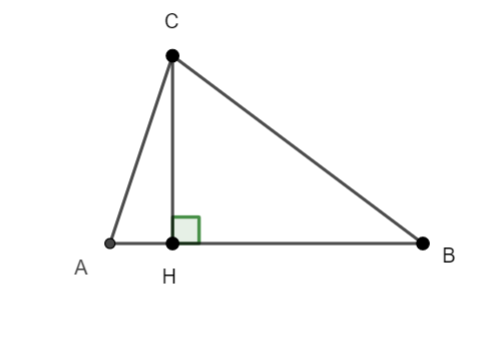
\overrightarrow{u}.\overrightarrow{v}=\overrightarrow{AB}.\overrightarrow{AC}
On projette les points A et C sur la droite (AB). A projette en A et C se projette en H.
\overrightarrow{u}.\overrightarrow{v}=-AB \times AH
car les vecteurs \overrightarrow{AB} et \overrightarrow{AH} sont de sens contraire.
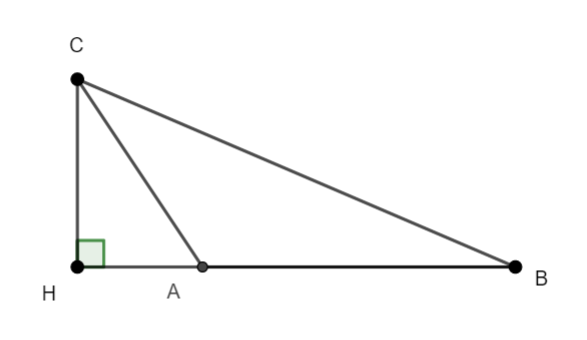
Exercice n°4
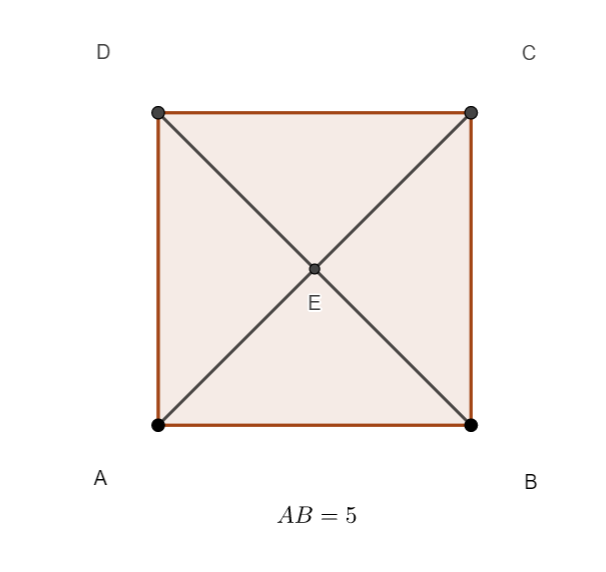
ABCD est un carré de côté 5.
En utilisant la propriété avec la projection orthogonale, calculer le produit scalaire \overrightarrow{AB}.\overrightarrow{AE}.
Exercice n°5
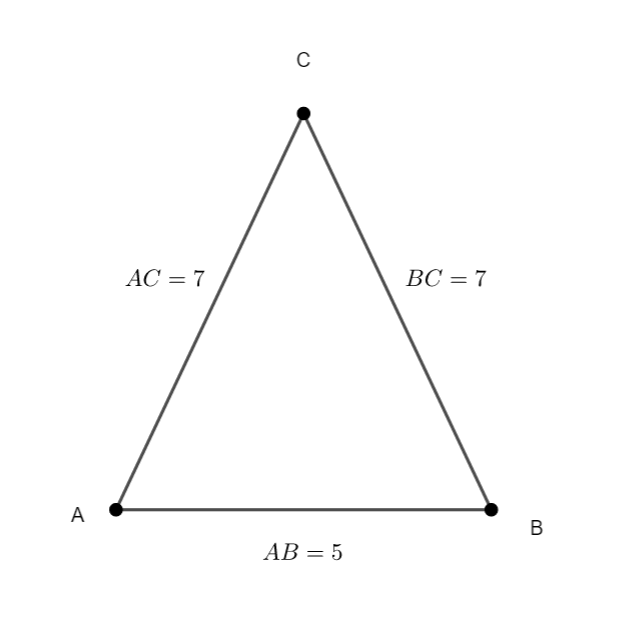
ABC est un triangle isocèle en C.
En utilisant la propriété avec la projection orthogonale, calculer le produit scalaire \overrightarrow{AB}.\overrightarrow{AC}.
Exercice n°6
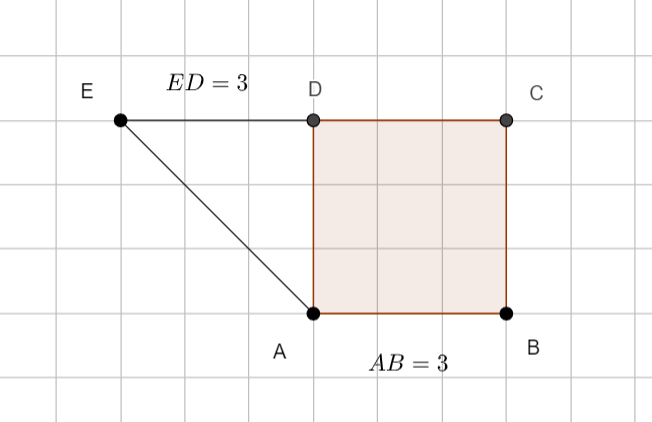
ABCD est un carré de côté 3 et EDA est un triangle isocèle et rectangle en D .
En utilisant la propriété avec la projection orthogonale, calculer le produit scalaire \overrightarrow{AB}.\overrightarrow{AE}.
Le produit scalaire et l’orthogonalité
Définition
Dire que deux vecteurs \overrightarrow{AB} et \overrightarrow{AC} sont orthogonaux signifie que les deux droites (AB) et (AC) sont perpendiculaires.
Le vecteur nul \overrightarrow{0} est orthogonal à tout vecteur.
Propriété
Pour tous vecteurs \overrightarrow{u} et \overrightarrow{v} , \overrightarrow{u} et \overrightarrow{v} sont orthogonaux équivaut à \overrightarrow{u}.\overrightarrow{v}=0.
Règles de calculs du produit scalaire
Propriétés
Pour tous vecteurs \overrightarrow{u}, \overrightarrow{v} et \overrightarrow{w}. Pour tout réel k
\overrightarrow{u}.\overrightarrow{v}=\overrightarrow{v}.\overrightarrow{u}
\overrightarrow{u}.(\overrightarrow{v}+\overrightarrow{w})=\overrightarrow{u}.\overrightarrow{v}+\overrightarrow{u}.\overrightarrow{w}
(\overrightarrow{u}+\overrightarrow{v}).\overrightarrow{w}=\overrightarrow{u}.\overrightarrow{w}+\overrightarrow{v}.\overrightarrow{w}
\overrightarrow{u}.(\overrightarrow{kv})=k(\overrightarrow{u}.\overrightarrow{v})
(\overrightarrow{ku}).\overrightarrow{v}=k(\overrightarrow{u}.\overrightarrow{v})
Exercice n°7
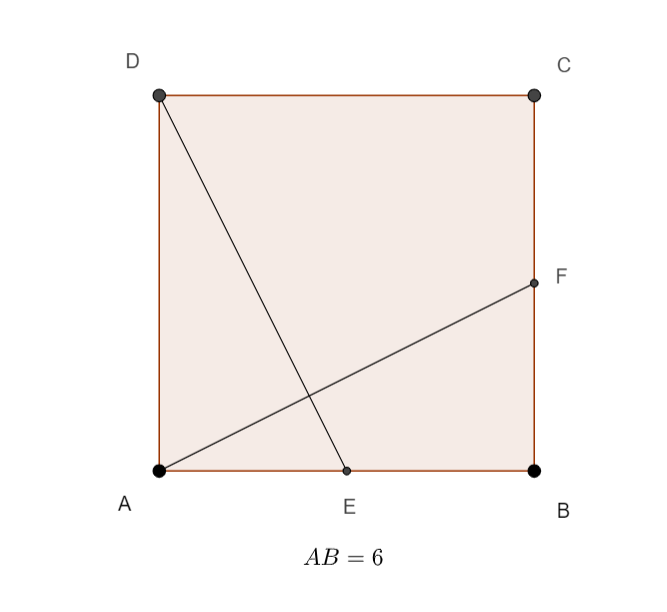
ABCD est un carré de côté 6 , E est le milieu de [AB] et F est le milieu de [BC].
L’objectif de cet exercice est de prouver que les droites (DE) et (AF) sont perpendiculaires.
- a) A l’aide de la relation de Chasles, compléter les pointillés suivants :\overrightarrow{DE}=\overrightarrow{DA}+…
- b) A l’aide de la relation de Chasles, compléter les pointillés suivants :\overrightarrow{AF}=…+\overrightarrow{BF}
- c) En utilisant les questions précédentes et les propriétés de calcul, montrer que
\overrightarrow{DE}.\overrightarrow{AF}=\overrightarrow{DA}.\overrightarrow{AB}+\overrightarrow{DA}.\overrightarrow{BF}+\overrightarrow{AE}.\overrightarrow{AB}+\overrightarrow{AE}.\overrightarrow{BF}
2.a) Calculer \overrightarrow{DA}.\overrightarrow{AB} en utilisant le fait qu’ils sont orthogonaux.
2.b) En utilisant la propriété avec la projection orthogonale, calculer le produit scalaire \overrightarrow{DA}.\overrightarrow{BF}.
2.c) En utilisant la définition, calculer le produit scalaire \overrightarrow{AE}.\overrightarrow{AB}.
2.d) Calculer \overrightarrow{AE}.\overrightarrow{BF} en utilisant le fait qu’ils sont orthogonaux.
3) A l’aide des questions 1 et 2, calculer le produit scalaire \overrightarrow{DE}.\overrightarrow{AF}. Que peut-on en déduire pour les droites (DE) et (AF) ?
Expression analytique du produit scalaire
Activité d’approche
Partie 1 : voici la base (\overrightarrow{i};\overrightarrow{j}) ci-dessous.
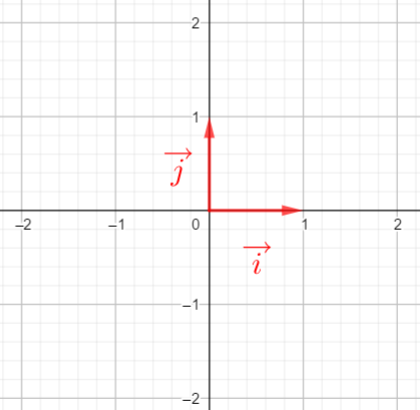
Calculer les produits scalaires suivants : \overrightarrow{i}.\overrightarrow{i}, \overrightarrow{i}.\overrightarrow{j} et \overrightarrow{j}.\overrightarrow{j}
Partie 2 : expression analytique de \overrightarrow{u}.\overrightarrow{v}
Soient \overrightarrow{u}(x;y) et \overrightarrow{v}(x';y') dans une base \overrightarrow{i};\overrightarrow{j}.
- En remplaçant \overrightarrow{u} par (x\overrightarrow{i}+y\overrightarrow{j}) et \overrightarrow{v} par (x'\overrightarrow{i}+y'\overrightarrow{j}), montrer que
\overrightarrow{u}.\overrightarrow{v}=xx'\overrightarrow{i}^2+xy'\overrightarrow{i}.\overrightarrow{j}+yx'\overrightarrow{j}.\overrightarrow{i}+yy'\overrightarrow{j}^2
2. En utilisant les résultats de la partie 1, finir le calcul de \overrightarrow{u}.\overrightarrow{v}.
Propriété
Soient \overrightarrow{u}(x;y) et \overrightarrow{v}(x';y') dans une base (\overrightarrow{i};\overrightarrow{j})
\overrightarrow{u}.\overrightarrow{v}=xx'+yy'
Exercice n°8
On se propose de montrer que les diagonales d’un carré sont perpendiculaires
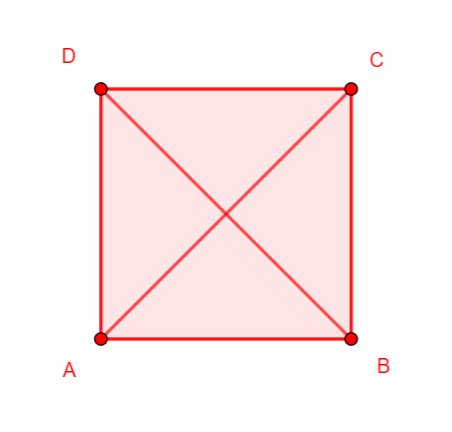
On choisit le repère orthonormé (A;\overrightarrow{AB}; \overrightarrow{AD}). C’est-à-dire que A(0;0), B(1;0) et D(0;1)
1.Déterminer graphiquement les coordonnées du point C.
2.Déterminer par le calcul les coordonnées des vecteurs \overrightarrow{AC} et \overrightarrow{BD}.
3.Calculer le produit scalaire \overrightarrow{AC}.\overrightarrow{BD}. En déduire la position des droites (AC) et (BD).
Exercice n°9 (version de l’exercice n°7 en utilisant le langage des coordonnées )
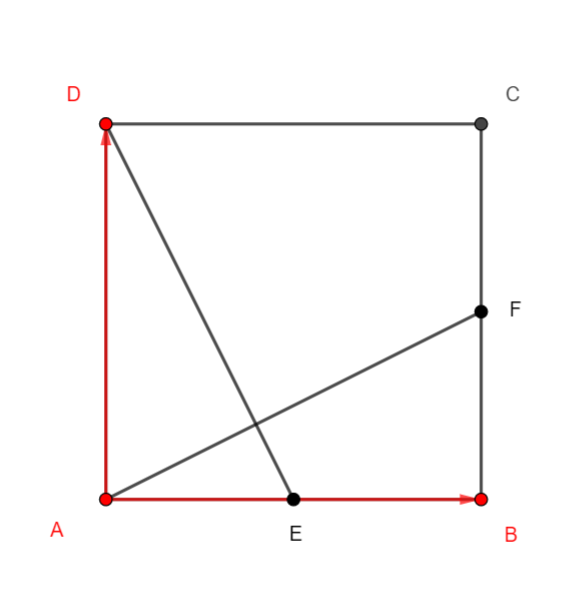
On choisit le repère orthonormé (A;\overrightarrow{AB}; \overrightarrow{AD}). C’est-à-dire que A(0;0), B(1;0) et D(0;1)
1.Déterminer graphiquement les coordonnées des points E et F.
2.Déterminer par le calcul les coordonnées des vecteurs \overrightarrow{DE} et \overrightarrow{AF}.
3.Calculer le produit scalaire \overrightarrow{DE}.\overrightarrow{AF}. En déduire la position des droites (DE) et (AF).
Le produit scalaire et les normes
Propriété n°1
\overrightarrow{u}^2 = ||\overrightarrow{u}||^2
Démonstration :
\overrightarrow{u}^2 = \overrightarrow{u}.\overrightarrow{u}\\\hspace{0.55cm} = ||\overrightarrow{u}||.||\overrightarrow{u}||.cos(0) d’après la définition du produit scalaire.
\hspace{0.55cm}= ||\overrightarrow{u}||.||\overrightarrow{u}||\\\hspace{0.55cm} = ||\overrightarrow{u}||^2
Exercice n°10 : formule de la médiane
Le but de cet exercice est de montrer la propriété suivante.
A et B sont deux points du plan et I est le milieu de [AB].
Pour tout point M du plan, on a
MA^2+MB^2=2MI^2+\frac{AB^2}{2}
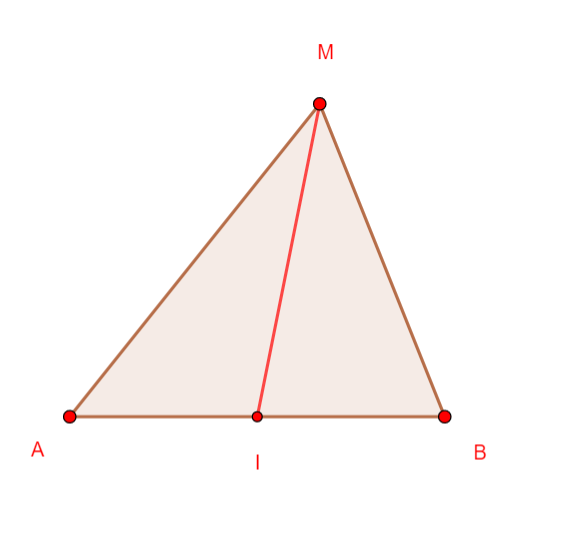
En utilisant la propriété n°1 ci-dessus, on peut écrire :
MA^2+MB^2=\overrightarrow{MA}^2+\overrightarrow{MB}^2
En utilisant la relation de Chasles , on peut écrire \overrightarrow{MA}^2=(\overrightarrow{MI}+\overrightarrow{IA})^2.
1.Développer (\overrightarrow{MI}+\overrightarrow{IA})^2
En utilisant la relation de Chasles , on peut écrire \overrightarrow{MB}^2=(\overrightarrow{MI}+\overrightarrow{IB})^2.
2.Développer (\overrightarrow{MI}+\overrightarrow{IB})^2
3.En ajoutant membre à membre les deux égalités précédentes, démontrer que
MA^2+MB^2=2MI^2+\frac{AB^2}{2}.
Propriété n°2
Pour tous vecteurs \overrightarrow{u} et \overrightarrow{v}.
||\overrightarrow{u}+\overrightarrow{v}||^2=||\overrightarrow{u}||^2+2\overrightarrow{u}.\overrightarrow{v}+||\overrightarrow{v}||^2
||\overrightarrow{u}-\overrightarrow{v}||^2=||\overrightarrow{u}||^2-2\overrightarrow{u}.\overrightarrow{v}+||\overrightarrow{v}||^2
Démonstration 1 :
||\overrightarrow{u}+\overrightarrow{v}||^2 = (\overrightarrow{u}+\overrightarrow{v})^2 d’après la propriété n°1
\hspace{1.7cm} =\overrightarrow{u}^2+2 \overrightarrow{u}.\overrightarrow{v}+\overrightarrow{v}^2 d’après les règles de calculs précédentes
\hspace{1.7cm} =||\overrightarrow{u}||^2+2 \overrightarrow{u}.\overrightarrow{v}+||\overrightarrow{v}||^2 d’après la propriété n°1
Démonstration 2 :
||\overrightarrow{u}-\overrightarrow{v}||^2 = (\overrightarrow{u}-\overrightarrow{v})^2 d’après la propriété n°1
\hspace{1.7cm} =\overrightarrow{u}^2-2 \overrightarrow{u}.\overrightarrow{v}+\overrightarrow{v}^2 d’après les règles de calculs précédentes
\hspace{1.7cm} =||\overrightarrow{u}||^2-2 \overrightarrow{u}.\overrightarrow{v}+||\overrightarrow{v}||^2 d’après la propriété n°1
Propriété n°3
Pour tous vecteurs \overrightarrow{u} et \overrightarrow{v}.
\overrightarrow{u}.\overrightarrow{v}=\frac{1}{2}(||\overrightarrow{u}||^2+||\overrightarrow{v}||^2- ||\overrightarrow{u}-\overrightarrow{v}||^2)
\overrightarrow{u}.\overrightarrow{v}=\frac{1}{2}(||\overrightarrow{u}+\overrightarrow{v}||^2)||-||\overrightarrow{u}||^2- ||\overrightarrow{v}||^2)